
Dear Friends:
The following is an excerpt from “Your Military Family Network,” a new book by The Military Family Network (MFN). Their mission is to support military families and increase their readiness and well being by connecting them with their communities and the organizations that provide the best service and value. This chapter features an interview with Dr. Frank Ochberg, Founder of Gift From Within, plus many helpful resources.
The goal of this section is to provide an introduction to PTSD for both the individual and the family. It is our hope that the information lays the groundwork for further exploration into this subject matter.
“Post Traumatic Stress and the Military”
Voices from the Field
“I recovered from PTSD. I served in Vietnam. Now my son is deploying to Iraq. I am afraid it will all come back and when he comes back, I am scared it will be the same for him,” said a middle aged Army nurse looking at some of the videotapes on PTSD produced by Gift from Within on display at a recent Military Family Network event.
She is not alone in her experience or her fears. In 2005, almost 216,000 veterans received PTSD benefit payments totally almost $4.3 billion dollars.
A 2006 Journal of the American Medical Association study shows that 9.8 percent of service members returning from Iraq have screened positive for PTSD symptoms and 11.9 percent were diagnosed with a mental disorder within the first year home. An additional 50,000 veterans from Iraq and Afghanistan are believed to be suffering from mental health problems – nearly half of them from Post Traumatic Stress Disorder, or PTSD.
When 22 soldiers killed themselves – accounting for nearly one in five of all Army non-combat deaths in 2005, Congress mandated a review of how the Department of Defense works to identify and treat members of the Armed Services suffering from PTSD.
PTSD as a Political issue
The United States is engaged actively in an ongoing war against terrorists. Although deployed to countries like Afghanistan and Iraq, territory or borders do not define the war. The tactics and strategies of the enemy are those of a new age- urban warfare where a-traditional, guerrilla attacks place service members on the frontline wherever they find themselves.
The majority of troops returns home and will not experience any long-term psychological concerns from their combat service.
However, the extended nature of the war has resulted in multiple redeployments and extensions for many military service members and their families. It is estimated by that nearly 20% of all returning veterans of this war will develop PTSD in their lifetime. Still more will experience a wider range of psychological affects from depression to anxiety concerns. Service members returning from war also experience higher rates of divorce, anger management and drug and alcohol issues.
The combat action faced by service members place them in constant and immediate danger of loss of limb and life. As the following chart demonstrates, almost all members of the Army know someone who has been seriously injured or killed in action.
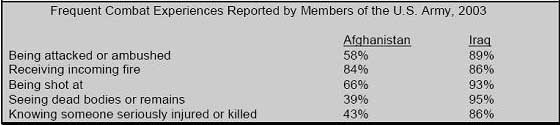
Source: National Center for PTSD
Dr. Frank Ochberg has decades of experience with traumatic stress. He is a founding board member of the International Society for Traumatic Stress Studies, founder of Gift From Within, author of the Stockholm Syndrome and former Associate Director of the National Institute for health.
According to Dr. Ochberg, increasing the education, awareness and availability of treatment for service members experiencing combat stress should be one of the highest priorities of the Armed Services.
 If this doesn't come from military families, it's not going to get the attention it deserves. And military families are in a powerful political position. They're not powerful in raising concerns that aren't asked for within the military chain of command. But at the ballot box, and in writing articles, and in entering into the national conversation, it's terribly, terribly important. People listen to widows. People listen to the parents of military, who have sacrificed. So we are talking about something that is crucial, and it's relevant, and it's timely. We can do what we're attempting to do here, which is to de-stigmatize, and normalize, symptoms of PTSD. If you are having flashbacks, and you know it, and yet, you are you have a military career, and you want to keep that career, you don't talk about the flashbacks.
 Front-line soldiers face extreme violence in Iraq. According to Department of Defense studies, more than 90 percent said they had been shot at. Nearly 20 percent said they saved someone's life. More than 80 percent of Marines said they saw injured women and children they had been unable to help.
Of those Iraq veterans surveyed who reported symptoms of mental distress, 40 percent of Army troops and 29 percent of Marines said they had sought professional help. The top reasons given for avoiding such help, from a multiple-choice list provided by the researchers, were, in order: “I would be seen as weak”; “My unit leadership might treat me differently”; “Members of my unit might have less confidence in me”; and “It would harm my career.”
A terrible irony exists for these combat veterans experiencing distress. Reporting has an impact on their careers, but reporting ensures timely help at the earliest point of onset and supports a rapid therapeutic process. Self-reporting is also complicated by the veteran’s perception of negative peer judgment, his own feelings of weakness for having distress and his internal struggle with guilt over leaving his unit to receive treatment.
Dr. Ochberg stresses that education is the key to removing the negative perceptions of PTSD:
 Once you've got it, it is a medical disorder, and it's best to consider it as such. Helps to get treatment for it. Helps to get information about it. Helps to have [ongoing] discussions so that family members can be up to speed and realize 'there but for the grace of God go I.' There's nothing morally wrong or physically wrong with the person who gets PTSD... and with a lot of adults who have served in uniform, branches of government, they manage to do their service, despite their feelings. All while they were on duty. But afterward, when you're safe, when you're in an entirely different environment, your body and your mind starts to react.
 War changes a person. Service members train everyday to serve their country, to fight and win America's wars. Prolonged exposure to hazardous environments, daily exposure to violence and death has a deep affect.
Dr. Ochberg’s life work speaks to helping people who have been exposed to trauma to heal. His message is one of hope and support to all service members and their families.
"I want to thank our men and women in uniform for their service. That service carries risk. That risk is to the body and to the spirit. Some of the wounds to the spirit take the pattern of PTSD or depression. They can be treated and treatment is good, and hopeful. Post-traumatic stress, depression; even alcoholism and even family discord are all treatable conditions. Sometimes, some of us have gone through hell, and we're never going to be exactly the same. We've seen things that we'd rather not admit exist. So, we may not be 'the same' but not being the same is okay," he said. Frequently Asked Questions about PTSD With Dr. Frank Ochberg
Q. What is PTSD?
A. PTSD is three different things at once.
The first of those three things is “trauma memory”. Trauma memory is different from usual memory. It comes back when you don’t want it to come back. It can wake you up in the middle of the night. It can be very subtle, so you’re not quite sure what it is until you realize, oh, my God, I’m having the feelings that I had when I was raped. That’s what’s going on. Or it can be very, very specific, like a hallucination. ‘I’m smelling what I was smelling when I was raped…I hear his voice, I feel his hand on me’. When it is what I just said, so real, like a hallucination, you don’t have any time sense. That’s very important. You don’t realize that it’s in the past. And it feels like it’s in the present. So it’s called “Re-experiencing” rather than remembering.
One of the things that is most important in working with people, who have a “trauma memory” is to help them develop a time sense, so they are not scared out of their wits. And therapy is all about transforming a trauma memory into an autobiographical memory. You don’t forget about it, but you know it’s in the past.
The second cluster of symptoms is almost the opposite. It’s feeling numb. It’s like having emotional anesthesia. And you’re really not the person you once were, and even though that emotional anesthesia may dampen down feelings of terror, they take away feelings of love, and hope, and connection. And there is a tendency of a person who feels numb is to avoid things. They avoid people, often people who might trigger the reminder of the traumatic event. They move into a shell and they’re not the person that they once were. It’s a very sad part of the disorder.
The last part of the disorder is being a nervous person. You’re easily startled, you don’t concentrate well, you don’t sleep well, you’re irritable. You can think of it as having a lot of adrenaline, although it doesn’t necessarily mean you do, it means that your threshold for being made anxious has been lowered a lot. That’s why, for a lot of people, PTSD is primarily an anxiety disorder, and they do well when they’re treated with the medication that helps with anxiety.
Q. Is PTSD the same as depression?
A. Because of the second cluster, it feels like depression. It technically is not depression. There’s nothing in a PTSD diagnosis that says that you are sad, hopeless, helpless, worthless, and if you are sad, hopeless, helpless, worthless, you have to call it both PTSD and depression.
For PTSD, there’s a clear precipitating event, and when it happened, you felt very scared, or horrified, or helpless at the time. That’s number one. Number two is you have all three clusters of symptoms and they’re all happening within a period of a month. The last part of the diagnosis is that the symptoms have gone on for at least a month after you were traumatized. You don’t call it PTSD if on the second day after you have symptoms.
Q. What is Acute Stress Disorder?
A. Acute Stress Disorder is used to identify the kind of people who are more likely to develop PTSD, based on their behavior, a few days after exposure. It’s almost exactly the same as PTSD, except you look for a little more trance-like symptoms early on, and that’s called, technically, dissociation.
When we are very, very shocked, traumatized, nervous, we go into a trance. If you think of the first meaning of shellshock, it is the image of the soldier on the battlefield, in a daze, corpses around, and the smell of gunpowder. There were battle scenes and people were thrown into an altered state of consciousness.
What’s meant by Acute Stress Disorder is that you have a reaction right away, you’re in a daze, and if that lasts for a while, there’s more of a chance of it becoming PTSD. If it continues for over a month, you no longer call it Acute Stress Disorder, you call it Post Traumatic Stress Disorder.
Need to Know
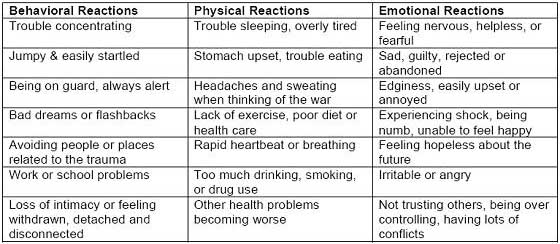
Some service members report feeling upset or “keyed up” even after they return home. Some may continue to think about events that occurred in combat, sometimes even acting as if back in a combat situation. These are common “combat stress reactions” (also called acute stress reactions) that can last for days or weeks and are a normal reaction to combat experiences. When these reactions continue for over a month, the service member may be experiencing PTSD.
Below is a list of common reactions:
Helpful Resources
The Military Family Network at emilitary.org
Gift from Within- a nonprofit corporation serving PTSD Clients and Professional Helpers
Some of Dr. Frank Ochberg’s articles include:
Veterans and Post-Traumatic Stress Disorder: A Conversation with Dr Frank Ochberg
The Iraq War Clinician Guide, 2nd Edition
National Center for PTSD
http://www.ptsd.va.gov/
The Unique Circumstances and Mental Health Impact of the Wars in Afghanistan and Iraq
A National Center for PTSD Fact Sheet.
Brett T. Litz, Ph.D.
http://www.ptsd.va.gov/
Traumatic Grief: Symptomatology and Treatment for the Iraq War Veteran
A National Center for PTSD Fact Sheet
Ilona Pivar, Ph.D.
http://www.ptsd.va.gov/
Recommendations for Pharmacological Treatment of Acute Stress Reactions
A National Center for PTSD Fact Sheet
http://www.ptsd.va.gov/
Chapter 4.1
“Treatment and Considerations for Post Traumatic Stress Disorder in Service Members”
Interview with and research by Dr. Frank Ochberg.
From the Field
“Ochberg’s Counting Method Supporting the Healing of Traumatic Memory”
The Counting Method is a newly devised brief treatment approach to the desensitization of PTSD symptoms. Developed by Frank Ochberg, MD, the Counting Method provides a parsimonious way to help clients process their traumatic memories without provoking high levels of affect. By overcoming their avoidant responses, clients are able to process the entire memory and thereby reduce their fear response, as in other behavioral treatments for anxiety.
The core of the method consists of a Preparation Phase, the Counting Phase where the therapist counts out loud from 1 to 100 as the client remembers the traumatic event, followed by a Review Phase. Preliminary research as well as clinical experience indicates significant reductions in arousal to traumatic memories can often by achieved in only a few sessions. Dr. Ochberg explains how the counting method would work with a client:
When a client is ready to try it, we set up a time. I'll have told them about the process. I count out loud, to a hundred; while I'm doing the counting they are letting themselves remember the traumatic event, without talking about it.
I'm sitting in my chair, they're sitting in theirs, and I can see them. By the time I'm counting to forty, fifty, there can be tears flowing, or their fists are all clenched up.

The instruction is to go through the whole event. I already pretty much know what they are going to be re-living. I tell them; when I'm counting in the forties and fifties, make sure that you're in the worst of it. And when I'm counting in the nineties, make sure you've reached a point in the memory where you're relatively safe. I time it very carefully. If I have an hour with the person, I do this in the beginning of the hour, so they have plenty of time to recover afterward.

Right after they're done with it, they usually come up as though they've come back from a trip to China. I give them time, sometimes they talk right away, sometimes I have to say,'Tell me what you just went through.' I have my yellow pad and I start writing down almost verbatim what they say. I try to get it all down.

Then, I go over it with them, and I read it back, and as I'm reading it back, I'll say things that are acknowledging, respecting them for what they have been through. I may say,' Well, it's not easy, and you remembered it all. That's good.' It puts me in memory. Because too often, people tell the trauma story in a mechanical way. They've told it to police officers, they've told it to another doctor, they're telling it, they're not really re-living it. This allows them to relive it in a safe environment- retelling it connected to their feelings.
For more information seeArticle: Frank M. Ochberg, M.D. The Counting Method for Ameliorating Traumatic Memories Article: David Read Johnson, Ph.D., and Hadar Lubin, M.D. The Counting Method as Exposure Therapy: Revisions and Case Examples Dr. Ochberg on “Getting Treatment”My goal is to make sure service members know that I respect them, for their service to my country, to our country. I respect them a lot. And as a doctor, who’s gone to Johns Hopkins Medical school, I am sure that emotional wounds are as significant as physical wounds. |
As a country, as a species, as human beings, it’s high time we paid the proper attention to emotional wounds, not be ashamed of them, or embarrassed by them, and when we need professional treatment, we get professional treatment.
And there are many doctors out there like me, who have a lot of respect for members of the Armed Forces, and have a lot of respect for PTSD. It’s a powerful enemy, in a way. And the way to defeat PTSD is to bring it out into the light.
Frequently Asked Questions (FAQ) With Dr. Frank Ochberg
Q. How can I find a good therapist? A. A lot of people say ‘trust your gut’, I never say trust your gut, because I don’t know if the person I’m talking to has the gut that they should trust. Some people don’t have very good instincts to help themselves. Good therapists have good reputations. Good therapists usually have no problems telling you about their education, their own life story; you can interview your therapist.
A good therapist can make you feel comfortable and confident. And it’s important to distinguish between-and this is hard to do-what the therapist is saying, or how they look, that makes you feel anxious, or awkward, and what you yourself are now beginning to bring up that makes you feel anxious or awkward.
A good therapist is going to lead you back through difficult experiences, and will try to lead you back in a way that you can tolerate it, grow from it, benefit from it, and you just feel it happening.
Need to Know: Treatment options for PTSD from the National Center for PTSD
PTSD Treatment
Participating in treatment for PTSD can be challenging, as patients are invited to directly face memories and feelings that they may have avoided for many years. Patients are much more likely to succeed in treatment if the following pre-requisites are in place:
- Patient is not abusing alcohol or using any street drugs. As stated earlier, substance abuse is often an issue for patients with PTSD. Patients need to learn skills (such as through a substance abuse treatment program) to cope with strong emotions such that they can directly face the traumatic memories without numbing themselves with substances.
- Patient has adequate coping skills (patient is not suicidal or homicidal).
- Patient has sufficient social support.
- Patient has a safe living situation (not homeless or in an abusive environment).
Although each patient’s individualized treatment plan is unique, the following goals are often important aspects of therapy:
- Examine and learn how to deal with strong feelings (such as anger, shame, depression, fear or guilt).
- Learn how to cope with memories, reminders, reactions, and feelings without becoming overwhelmed or emotionally numb. Trauma memories usually do not go away entirely as a result of therapy, but become less frequent and less intense.
- Discover ways to relax (possibly including physical exercise).
- Increase the frequency of patient’s pleasant activities.
- Re-invest energy in positive relationships with family and/or friends.
- Enhance sense of personal power and control in his/her environment
Components of treatment for PTSD
Most treatment programs involve a comprehensive approach, including several modalities:
- Psychiatric medications
- Education for client and family
- Group therapy
- Cognitive behavioral therapy
- Writing exercises
- Psychiatric Medications
- Choice of medication(s) depends on the patient’s specific symptoms and any co-morbid difficulties (e.g., depression, panic attacks)
- In general, medications can decrease the severity of the depression, anxiety and insomnia. However, there is no “cure” for PTSD.
- Medications may be prescribed by the patient’s primary care provider or psychiatrist.
Education for patient and family about PTSD
- Education is very important, both for the patient and the family. It typically addresses the nature of PTSD (e.g., symptoms, course, triggers), communication skills, problem-solving skills, and anger management.
- The education may occur in a variety of modalities, such as couples/family therapy, psychoeducational programs, support groups, etc.
Group Therapy
- In general, groups “counter the profound sense of isolation, social withdrawal, mistrust, and loss of control. The acknowledgment by victims that they are not alone, can support others, and can safely share their traumatic experiences within a responsive social context provides an opportunity for healing.” (Hadar Lubin, MD, 1996).
- Groups have a variety of formats, including: process oriented, trauma oriented (e.g., telling one’s story), present-day focused (e.g., coping skills), and/or psychoeducational (e.g., anger management)
Cognitive/behavioral therapy
- Cognitive therapy involves inviting patients to examine their thinking processes and replace irrational thoughts with more realistic thoughts. This form of therapy has received strong research support. Cognitive restructuring is a cognitive therapy approach used with PTSD.
- Behavioral therapy involves inviting patients to change their behaviors, which results in a shift in their mood / mental state. Behavioral interventions may include teaching relaxation techniques, imagery, and breathing techniques.
- Anger management training may involve both cognitive and behavioral skills.
- Exposure based therapy (e.g., flooding, desensitization) involves helping the patient to repeatedly “re-tell” the traumatic experience in great detail, such that the memory becomes less upsetting. Researchers have found this approach to be very effective in decreasing symptoms of PTSD.
Helpful Resources
Help for Veterans with PTSD
A National Center for PTSD Fact Sheet
http://www.ptsd.va.gov/
War-Zone-Related Stress Reactions: What Veterans Need to Know
A National Center for PTSD Fact Sheet
http://www.ptsd.va.gov/
Resources for U.S. Service Members Returning from Deployment
A National Center for PTSD Fact Sheet
http://www.ptsd.va.gov/
Returning from the War Zone: A Guide for Military Personnel
A National Center for PTSD Fact Sheet
http://www.ptsd.va.gov/
When the Letdown Doesn’t Let Up
National Mental Health Association
www.nmha.org/reunions/infoLetdown.cfm
How to Get Back to “Normal”
National Mental Health Association
www.nmha.org/reunions/infoBacktoNormal.cfm
Beverly J. Anderson, Ph.D., B.C.E.T.S. Help for Officers returning from the war in Iraq.
Reintegration & Readjustment Program For Iraqi Veterans: for officers returning from the war in Iraq
DVD Living with PTSD: Lessons for Partners, Friends and Supporters
This program featuring Dr. Frank Ochberg and Dr. Angie Panos is valuable for those who care about the PTSD sufferer in their life. It explains what PTSD is, why it is important to learn about this medical disorder, what you can do to help, ways to treat it, how to deal with caregiver burden and how PTSD affects the family and other relationships.
Dr. Ochberg is a psychiatrist and former associate director of the National Institute of Mental Health. He is one of the team members who wrote the medical definition for Post Traumatic Stress Disorder and a recipient of a lifetime achievement award from the International Society for Traumatic Stress Studies. 58 minutes. $l5.00.
The Military Family Network at www.militaryfamilynetwork.com
Chapter 4.2
“Post Traumatic Stress Disorder and Military Families”
Interview with and research by Dr. Frank Ochberg.
Voices from the Field
My name is Stefanie Pelkey and I am a former Captain in the U.S. Army. This testimony is on behalf of my husband, CPT Michael Jon Pelkey, who died on November 5, 2004. Although he was a brave veteran of Operation Iraqi Freedom, he did not die in battle, at least not in Iraq. He died in a battle of his heart and mind. Michael passed away in our home at Ft. Sill, Oklahoma from a self-inflicted gunshot wound to the chest. I feel that my husband is a casualty of this war and to date the Army has not done enough for post-traumatic stress.
Stephanie Pelkey’s Congressional Testimony, 2005
There are thousands of soldiers across the country coming home with minds tortured by what they’ve experienced in Iraq.
An Army study published in The New England Journal of Medicine found that approximately. 19.1% of soldiers and Marines who returned from Iraq met risk criteria for a mental health concern, compared with 11.3% for those deployed to Afghanistan and 8.5% for those sent to other locations. The Army’s first study of the mental health of troops who fought in Iraq found that about one in eight reported symptoms of post-traumatic stress disorder.
The Walter Reed Army Institute of Research survey also showed that less than half of those with problems sought help, mostly out of fear of being stigmatized or hurting their careers.
How can couples prepare for the chance that a traumatic combat event may affect the well being of a returning loved one? What happens when dinnertime is quiet or your spouse explodes for no reason. It is a difficult situation. While most service members come home without significant concerns, the ones that do return home hurt need support from their loved ones and from trained professionals.
Dr. Frank Ochberg suggests that sometimes the service member is not ready to see a professional, but recommends that the spouse can reach out and start the process:
It’s usually the wife who wants help and the husband who doesn’t. And the husband is either embarrassed or he feels he can’t control his temper…and he doesn’t want to get himself triggered. Because he knows that’s going to make it a whole lot worse. Sometimes what I do is more like shuttle diplomacy. I try to get the guy involved, just seeing me. It usually works out pretty well, ’cause a lot of these guys will say, “I’ve got an anger management problem.” And then you can work on it with them.
It's usually the wife who wants help and the husband who doesn't. And the husband is either embarrassed or he feels he can't control his temper...and he doesn't want to get himself triggered. Because he knows that's going to make it a whole lot worse. Sometimes what I do is more like shuttle diplomacy. I try to get the guy involved, just seeing me. It usually works out pretty well, 'cause a lot of these guys will say, "I've got an anger management problem." And then you can work on it with them.
However, less than fifty percent of affected veterans seek help for trauma related distress. Unfortunately, the primary key to the success of a therapeutic option is the acceptance and willingness of the victim to seek help. If the service member is not ready to reach out, the spouse reaching out for professional support is the best place to start to help build coping mechanisms and a tool box to sustain the family through the time of adjustment.
Frequently Asked Questions (FAQ) With Dr. Frank Ochberg
Q. What happens if my spouse acts out in front of the children? How do I talk to them about PTSD?
A. It may depend on Daddy and on the way it’s being manifest. If it’s that Daddy is hitting the bottle and behaving in a destructive way, then it could be pretty firm, ‘That’s your Dad, that’s my husband, he did something wrong. Now, we respect him, but we’ve got to figure out how we’re going to help him and it’s not going to be easy’.
Q. Should I talk with my husband about what to say to the kids?
A. Yes. If you’re the wife, say, ‘Charlie, let’s face it, you’ve got PTSD, like a million other people. Now, are you okay with me telling the kids about this? We want to learn about it’. And if Charlie says, “Hell, yes, I’d like you to know’, no problem. If Charlie says ‘Well, I don’t think they’re ready for it’, that’s a different conversation.
If Charlie says, ‘No, this is private, I don’t want anyone knowing’, that’s another condition. If you can get it to the point where that it’s okay to tell the kids, and to tell family, that is good. My message to the family member or the friend is, you want to be the smartest person on your block about PTSD. You’ve got PTSD that’s affecting someone you love. You get a crash course; you get yourself up to speed.
Q. What should I do if my spouse is having a flashback or night terror, sometimes it scares me a lot to hear my spouse or see him.
A. Fear is a fundamental and helpful human emotion. If you are afraid, do what you need to do to protect yourself. Ask him, when he’s not having a flashback, what he would like you to do. Some guys might say, oh, get out of there. Some of them might say, ‘Pinch me.’ Some might say, ‘If you touch me, you’ll make it worse.’ Some common-sense things that if you think that this perhaps is entering a flashback or a nightmare, do what you can to wake him up, bring him back.
Additional FAQ from the National Center for PTSD
Q. What are the typical patterns of how children respond to a parent with PTSD?
A. Researchers have observed a direct relationship between each of the parent’s PTSD symptoms and the children’s responses. Researchers also have noticed patterns in the ways children respond to the parent’s overall presentation of PTSD. Harkness (1991) described three typical ways these children respond: (1) the over-identified child: the child experiences secondary traumatization and comes to experience many of the symptoms the parent with PTSD is having; (2) the rescuer: the child takes on parental roles and responsibilities to compensate for the parent’s difficulties; and (3) the emotionally uninvolved child: this child receives little emotional support, which results in problems at school, depression and anxiety, and relational problems later in life.
These theories certainly do not represent every possible reaction children may have to parents with combat-related PTSD, but they offer some useful ways of understanding how symptoms might develop for these children.
Q. What are the common problems children of veterans with PTSD face?
Social & behavioral problems
Research has shown that there is significantly more violence in families of Vietnam veterans with PTSD than in families of veterans without PTSD, including increased violent behavior of the child. Several studies have examined the effect that fathers’ combat-related PTSD and violent behaviors have on their children. Results have generally revealed that children of veterans with PTSD are at higher risk for behavioral, academic, and interpersonal problems. Their parents tend to view them as more depressed, anxious, aggressive, hyperactive, and delinquent compared to children of non-combat Vietnam era veterans (who do not have PTSD). In addition, the children are perceived as having difficulty establishing and maintaining friendships. Chaotic family experiences can make it difficult to establish positive attachments to parents, which can make it difficult for children to create healthy relationships outside the family too. There is also research showing that children may have particular behavioral disturbances if their parent veteran participated in abusive violence (i.e., atrocities) during combat service.
Emotional problems and secondary traumatization
Results have also shown that children of veterans with PTSD are at higher risk for being depressed and anxious than non-combat Vietnam era veteran’s children. Children may start to experience the parent’s PTSD symptoms (e.g., start having nightmares about the parent’s trauma) or have PTSD symptoms related to witnessing their parent’s symptoms (e.g., having difficulty concentrating at school because they’re thinking about the parent’s difficulties). Some researchers describe the impact that parents’ PTSD symptoms have on a child as secondary traumatization. However, because of the increased likelihood that violence occurs in the home of a veteran with PTSD, it is also possible that children develop PTSD symptoms of their own. Having a seemingly unsupportive parent can compound these symptoms.
Q. Can children get PTSD from their parents?
A. It is possible for children to display symptoms of PTSD because they are upset by their parent’s symptoms (secondary traumatization). Some researchers have also investigated the notion that trauma and the symptoms associated with it can be passed from one generation to the next. Researchers describe this phenomenon as intergenerational transmission of trauma. Much research has been conducted with victims of the Holocaust and their families (see Kellerman7 for review), and some studies have expanded on these ideas to include families of combat veterans with PTSD.
Ancharoff, Munroe, and Fisher described several ways to understand the mechanisms of intergenerational transmission of trauma. These mechanisms are silence, overdisclosure, identification, and reenactment. When a family silences a child, or teaches him/her to avoid discussions of events, situations, thoughts, or emotions, the child’s anxiety tends to increase. He or she may start to worry about provoking the parent’s symptoms. Without understanding the reasons for their parent’s symptoms, children may create their own ideas about what the parent experienced, which can be even more horrifying than what actually occurred. Overdisclosure can be just as problematic. When children are exposed to graphic details about their parent’s traumatic experiences, they can start to experience their own set of PTSD symptoms in response to the horrific images generated. Similarly, children who live with a traumatized parent may start to identify with the parent such that they begin to share in his or her symptoms as a way to connect with the parent. Children may also be pulled to reenact some aspect of the traumatic experience because the traumatized parent has difficulty separating past experiences from present.
Q. What should I do if I feel my or my partner’s PTSD is affecting my children?
A. Preventive interventions can be helpful and include explaining to family members the possible impact of intergenerational transmission of trauma, before it happens. Education about the potential impact on children can also be a useful reactive response, when a child is already being affected by his or her parent’s trauma history.
An excellent first step in helping children cope with a parent’s PTSD is to explain the reasons for the traumatized parent’s difficulties, without burdening the child with graphic details. It is important to help children see that the symptoms are not related to them; children need to know they are not to blame. How much a parent says should be influenced by the child’s age and maturity level. Some parents may prefer to have help with what they say to their children, and seeking assistance through therapy or written materials can be helpful. The National Center for PTSD’s fact sheet below on “Children and Disasters” can help parents talk to children about trauma. This fact sheet also describes how children may react differently, depending on the child’s age.
Need to Know
- Do not push or force your loved one to talk about the details of his/her upsetting memories. Try to avoid feeling jealous if your loved one shares more with other survivors of similar traumas or to his/her therapist than to you. Rather, be pleased for them that they have a confidant with whom they feel comfortable.
- Do not pressure your loved one to talk about what he/she is working on in therapy. Also, avoid trying to be his/her therapist.
- Attempt to identify (with your loved one) and anticipate some of his/her triggers (e.g., helicopters, war movies, thunderstorms, violence). Learn and anticipate some of his/her anniversary dates
- Recognize that the social and/or emotional withdrawal may be due to their own issues and have nothing to do with you or your relationship.
- Do not tolerate abuse of any kind – financial, emotional, physical, or sexual. Individuals with PTSD sometimes try to justify their behavior (e.g. angry outbursts, destroying property, lying) and “blame” their wrongdoing on having this psychiatric disorder. Patients may try to rationalize their behavior by stating that they were “not themselves” or “not in control” or “in another world.” However, patients should always be held responsible for their behavior.
- Pay attention to your own needs.
- Take any comments that your loved one makes about suicide very seriously and seek professional help immediately.
- Do not tell your loved one to just “forget about the past” or just “get over it.”
- Explore the available treatment options in your community, and encourage your loved one to seek professional help. However, respect that they know if/when they are ready to take this courageous step, and do not pressure them excessively.
References
1. Jordan, B. K., Marmar, C. B., Fairbank, J. A., Schlenger, W. E., Kulka, R. A., Hough, R. L., et al. (1992). Problems in families of male Vietnam veterans with posttraumatic stress disorder. Journal of Consulting and Clinical Psychology, 60, 916-926.
2. Cosgrove, L., Brady, M. E., & Peck, P. (1995). PTSD and the family: Secondary traumatization. In D. K. Rhoades, M. R. Leaveck, & J. C. Hudson (Eds.), The legacy of Vietnam veterans and their families: Survivors of war: catalysts for change (pp. 38-49). Washington: Agent Orange Class Assistance Program.
3. Harkness, L. (1993). Transgenerational transmission of war-related trauma. In J. P. Wilson & B. Raphael (Eds.), International handbook of traumatic stress syndromes (pp. 635-643). New York: Plenum Press.
4. Parsons, J., Kehle, T. J., & Owen, S. V. (1990). Incidence of behavior problems among children of Vietnam War veterans. School Psychology International, 11, 253-259.
5. Rosenheck, R., & Fontana, A. (1998). Transgenerational effects of abusive violence on the children of Vietnam combat veterans. Journal of Traumatic Stress, 11, 731-742.
6. Dansby, V. S., & Marinelli, R. P. (1999). Adolescent children of Vietnam combat veteran fathers: A population at risk. Journal of Adolescence, 22, 329-340.
7. Kellerman, N. (2001). Psychopathology in children of Holocaust survivors: A review of the research literature. Israel Journal of Psychiatry and Related Sciences, 38, 36-46.
8. Ancharoff, M. R., Munroe, J. F., & Fisher, L. M. (1998). The legacy of combat trauma: Clinical implications of intergenerational transmission. In Y. Danieli (Ed.), International handbook of multigenerational legacies of trauma (pp. 257-275). New York: Plenum Press.
9. Harkness, L. (1991). The effect of combat-related PTSD on children. National Center for PTSD Clinical Quarterly, 2(1).
Helpful Resources
Military Family Resources
The Military Family Network at www.militaryfamilynetwork.com
Gateway to PTSD Information
www.ptsdinfo.org
Guide for Families from the National Center for PTSD
http://www.ptsd.va.gov/
Down Range: To Iraq and Back (2005).
Bridget Cantrell, Ph.D., Chuck Dean
Courage After Fire: Coping Strategies for Troops Returning from Iraq and Afghanistan and Their Families (2006).
Keith Armstrong, Suzanne Best, Paula Domenici
National Center for PTSD
http://www.ptsd.va.gov/
S.A.F.E. Program, Support And Family Education: Mental Health Facts for Families. An 18 session curriculum for people who care about someone who has a mental illness or PTSD. Entire curriculum is available for free download on website. http://w3.ouhsc.edu/Safeprogram/ Courage to Care (Uniformed Services University of the Health Sciences)
www.usuhs.mil/psy/courage.html
Mental Health Self-Assessment Program (DOD sponsored anonymous mental health / alcohol screening and referral program offered to families and service members affected by deployment or mobilization – available online 24/7)
www.MilitaryMentalHealth.org.
Resources for Working with Military Personnel and Their Families (Ken Pope’s website)
www.kspope.com/torvic/war.php
VA’s Seamless Transition Office
www.seamlesstransition.va.gov
My HealtheVet: The Gateway to Veteran Health and Wellness
www.myhealth.va.gov
Operation: Military Kids
Army’s efforts to support youth of National Guard & Army reserve families
www.operationmilitarykids.org
DOD’s Military Student Program: The Military Child in Transition and Deployment
www.militarystudent.dod.mil/
Guard Family Youth Website
www.guardfamilyyouth.org
Operation Healthy Reunions (part of the National Mental Health Association)
www.nmha.org/reunions/index.cfm
PTSD and the Family
A National Center for PTSD Fact Sheet
Eve B. Carlson, Ph.D. and Joseph Ruzek, Ph.D.
http://www.ptsd.va.gov/
Reintegration Fact Sheet for Providers
Courage to Care, Uniformed Services University of the Health Sciences
www.usuhs.mil/psy/RFSP.pdf
Talking to Children About Going to War
A National Center for PTSD Fact Sheet. IlonaPivar, Ph.D.
http://www.ptsd.va.gov/
Parent’s Guide for Talking to their Children About War
National Center for Children Exposed to Violence. Yale Child Study Center.
http://www.teachervision.fen.com/tv/printables/parentwar.pdf
The Emotional Cycle of Deployment: A Military Family Perspective
www.hooah4health.com/deployment/familymatters/emotionalcycle.htm
Homecoming Preparedness for Veterans and Families: A Self-Help Guide to Ease the Transition from Deployment and the Military to Civilian Life
Veterans and Families Homecoming Support Network
http://www.speaker.gov/pdf/Stafford.doc
Becoming a Couple Again: How to Create a Shared Sense of Purpose after Deployment
Courage to Care, Uniformed Services University of the Health Sciences
www.usuhs.mil/psy/RFSMC.pdf
Being a Couple Again
National Mental Health Association
www.nmha.org/reunions/infoCouple.cfm
A Soldier and Family Guide to Redeploying
DOD Deployment Health Clinical Center
chppm-www.apgea.army.mil/deployment/FamilyReunionTrifold19Dec03.pdf
Coping When a Family Member Has Been Called to War
A National Center for PTSD Fact Sheet. Julia Whealin, Ph.D. & Ilona Pivar, Ph.D
http://www.ptsd.va.gov/
Helping Children Cope During Deployment
Courage to Care, Uniformed Services University of the Health Sciences
http://www.fylrr.com/archives.php?doc=CTChildrenCopeDuringDeployment.pdf
Deployment Guide For Families of Deploying Soldiers. Separation and Reunion Handbook
www.hooah4health.com/deployment/familymatters/reunion.htm#
Returning from the War Zone: A Guide for Families
http://www.ptsd.va.gov/
Welcome Home: How to make a difference in the lives of returning war zone veterans (includes Dr. James Munroe’s “Eight Battlefield Skills that Make Life in the Civilian World Challenging”)
Washington Family Policy Council
www.fpc.wa.gov/Welcome%20Home.pdf
Helping Children and Youth Cope with the Deployment of a Parent in the Military Reserves (has information for parents, teachers, pediatricians, etc)
SOFAR (Strategic Outreach to Families of All Reservists) Guide
http://www.speaker.gov/pdf/Stafford.doc
Getting Home: All the Way Home
Free DVD created by TriWest (TRICARE Contractor in the West Region) for soldiers & their families (only for individuals in TriWest’s catchment area)
Chapter 4.3
Toolkit from the S.A.F.E. Program
What We’d Like our Family Members and Friends To Know about Living with PTSD
Michelle D. Sherman, Ph.D.
Director, Family Mental Health Program
Oklahoma City Veterans Affairs Medical Center
- GIVE ME SPACE when I need to be alone – don’t overwhelm me with questions. I’ll come and talk to you when I’m ready.
- Get away from me if I am out of control, threatening or violent.
- Be patient with me, especially when I’m irritable.
- Don’t personalize my behavior when I explode or get quiet.
- Learn and rehearse a time out process.
- Don’t patronize me or tell me what to do. Treat me with respect and include me in conversations and decision making.
- Don’t pity me.
- Don’t say “I understand” when there are some things that you cannot understand.
- Realize that I have unpredictable highs and lows – good and bad days.
- Anticipate my anniversary dates – recognize that these could be tough times.
- I’d like to share my traumatic experiences with you, but I fear overwhelming you and losing you.
- I want to be close to you and share my feelings, but I’m afraid to … and sometimes I don’t know how to express my emotions.
- I also fear your judgment.
- Know that I still love and care about you, even if I act like a jerk sometimes.
- Don’t ask me to go to crowded or noisy places because I’m uncomfortable in those settings.
Family Concerns and the PTSD veteran abstracted from the National Center for PTSD
Social anxiety
- Families may become isolated due to the social anxiety many veterans experience. As veterans often feel very uncomfortable in large groups and crowds, the family may be quite limited in their activities.
- The veteran may pressure the family members (directly and/or indirectly) to stay home with him, thereby narrowing caregivers’ social contacts and limiting their ability to obtain support. Family members often feel guilty for pursuing independent activities.
Angry Outbursts
- Anger is often a “weapon” in the veteran’s arsenal of protection against painful feelings, memories, and thoughts. Anger can function as a barrier and further isolate the veteran, as other people often pull away from the frightening hostility and rage.
- Due to the veteran’s difficulty in managing his anger, the family may live in an atmosphere of constant chaos. This lack of emotional and sometimes physical safety can be damaging to the mental health and development of all family members.
- Family members may be at greater risk for being exposed to verbal abuse (e.g., yelling, name calling) and physical abuse (e.g., throwing things, aggression). Both veterans with PTSD and their spouses / partners engage in higher levels of physical violence than do comparable family members when the veteran does not have PTSD (Jordan et al., 1992). These repeated negative interactions damage the trust and cohesion within the family.
- Children may acquire maladaptive patterns for the expression of anger. A large nation-wide survey revealed that the children of Vietnam veterans with PTSD are more apt to have behavioral problems than children of Vietnam veterans who do not have this disorder (Jordan et al., 1992).
- Wives are often torn between caring for the acting-out veteran and protecting the children from his angry outbursts (Glynn, 1997).
- The rage exhibited publicly may further alienate the family from their social network.
Emotional unavailability:
- Patients with PTSD may be emotionally unavailable due to preoccupation with managing mental stress. The emotional distance in the relationship may also stem from the higher levels of fear of intimacy experienced by both veterans with PTSD and their partners (in comparison to couples in which the veteran does not have PTSD) (Riggs, Byrne, Weathers, & Litz, 1998).
- The veteran may be reluctant or unwilling to share his feelings with his wife and children (Matsakis, 1989). Consequently, family members may feel rejected and lonely, and they may blame themselves for their loved one’s emotional distance.
- The individual may struggle with experiencing and expressing positive emotions. He may be unavailable to his children and unable to meet their emotional needs (Curran, 1997)
Sleep disturbance
- Given the difficulties many veterans with PTSD have with sleep (including insomnia, frequent wakings, nightmares, etc.), many couples choose to sleep in separate beds (and rooms). This physical separation can parallel the emotional distance experienced in the relationship. Physical intimacy can also be adversely affected by this sleeping arrangement.
- In addition, the veteran’s behavior during a nightmare can be very frightening for the spouse and family. In the midst of a nightmare or flashback, some patients become physically aggressive, thinking that their wife/partner is the enemy in a combat situation. Wives often report extreme terror and confusion about these experiences, as they do not understand the out of control behavior.
Difficulty managing family roles and responsibilities
- Given the veteran’s emotional instability, the wife may assume some traditionally-male roles, such as primary breadwinner, “head of the household,” manager of family finances, and chief disciplinarian. The wives may feel overwhelmed by all of the demands in their lives, and wives may resent the veteran’s withdrawal from familial responsibilities (Peterson, 1997).
- Given that the wife has taken over many of the veteran’s tasks, she may be unable to pursue her own goals (Matsakis, 1989), which can breed further bitterness.
- Children may acquire adult responsibilities at an earlier age, resulting in their maturing quickly and sometimes taking on the role of a “parentified child” (Catherall, 1997).
- Individuals with PTSD often have difficulty keeping their jobs, thereby creating financial duress on the family.
Click here to purchase a copy of “Your Military Family Network.”
Content may not be reproduced on websites without express permission. Please feel free to add a link to this page.
Thank you.
Please be aware that the materials on this website are intended for educational purposes.
This is not meant to replace or act as a substitute for the care and advice given to you by your own clinician or mental health counselor.