“Iron Man Family Outing: Poems About Transition Into a More Conscious Manhood,” by Rick Belden. 1990. (Amazon rating 5 stars). $11.95. |
A relatively short work (around a hundred pages), illustrated in some parts, the author has divided his work into seven parts that seem to follow his journey from childhood to adulthood and from pain into hope. His poetry deals with every important aspect of life including love, sex, family relationships and how pain, cruelty and withholding of love affects a child for every part of his future.
I would love to put a copy of this book into the hands of every male I know, but I also encourage those of my gender who seek to better understand the male psyche to pick up a copy of this book. Ordering information was not included but the author may be reached at https://www.rickbelden.com/
“Wounded Boys: Heroic Men: A Man’s Guide To Recovering From Child Abuse,” by Daniel Jay Sonkin, Ph.D. (Amazon rating 5 star). $11.01. |
I believe this an excellent book for men who are in the beginning stages of acknowledging their childhood abuse issues. It is done in a workbook format and is unintimidating and written for the abused man although a spouse or girlfriend or significant other will also learn a lot about the negative behavior of those they care about. A most important issue for the abused male is to learn to acknowledge the abuse, to slowly get comfortable saying “I was abused.” Then learning how to deal with the emotional, psychological scars and feelings that have affected their thinking and behavior. Behavior that may have wrecked relationships, careers and the constant inner/self abuse. Dr. Sonkin shows through case examples the ways abused men have learned to help themselves put a break on their negative behaviors including perpetuating cycles of violence, depression, and anger. Abused men can change and lives can get better and relationships can improve. It starts with you, and this book will help you on your healing journey.
“A Matter of Time,” by Nancy Rae (Amazon rating 5 star). $16.16. |
This book is unique in that it is the story of a male victim of child sexual abuse written by a woman. It is unique to GFW readers in that we seldom hear much about the struggles men face who suffered the type of abuse many of our members faced. To me this story was valuable because of the insight it offered to our male counterparts and also because it brought home, once again, the fact that there is no cure for PTSD but that we can live a meaningful life and that our symptoms can lesson, especially when we have and accept the support of our friends, peers and family.
Nancy Rae chronicles the fictional story of David who was victimized as a child and as an adult and his long struggle to accept himself, to understand himself and to understand he was not to blame for what he suffered. It also clearly portrays the importance of accepting love and support from those who want to reach out to us, the hurt when those we do love are not able to understand us, and the damage done when those we trust to help us, namely therapists, end up abusing our vulnerability and trust to their own ends.
Although this is a fictional story, one can see that the author is acquainted with those who have lived this struggle, and that she has done research on the subject of sexual abuse of males, a subject often overlooked because men are taught they have to be strong and that it is weak to ask for help.
I found this book touching and informative and I feel it is a story that needs to be told. I also feel our members would find this book a valuable addition to their libraries and a research tool for those interested in this subject. If you know a man who has suffered abuse, this book would make a great gift as a tool for reaching out to someone who may not open up in a face to face conversation.
Inspirational:
“Abraham: A Journey to the Heart of Three Faiths.” by Bruce S. Feiler. (Amazon rating 4 stars). $10.36. |
This is the story of one person’s personal exploration about Abraham. It is about how Christians, Jews and Muslims all lay claim to being Abraham’s original heirs. This book is beautifully written and will give the novice reader of religious history a good introduction to the similarities and differences between the 3 religions. There are no answers but it is fascinating how the author discusses Abraham, a man who started out as a spiritual father and then became the personal property of these religions. I appreciate the author using the word Heart in his title as that is what we all need to pay attention to.
“Callings : Finding and Following an Authentic Life.” by Gregg Michael Levoy. (Amazon rating 4.5 stars). $10.61.
This book will bring a smile to your lips. It is so very interesting because it attempts to answer questions we have had at one time or another in our lives. What am I supposed to be doing? How do I know this is what I am? How do I know if I’m following my true calling and if not, what do I do about it? This book is beautifully written by Gregg Levoy who has examined his own life in this way. He lectures and teaches about callings. He gives us wonderful stories and examples of people who discovered their callings. He allows us to examine what may or may not be true calls or “siren calls.” Gregg Levoy uses metaphors, psychology and spirituality interwoven with wonderful true stories of people who have found their “center.”
“The Listening Project.” I loved this story of a woman who in the l960’s meditated daily and asked herself a single question. “What can I do to help the earth?” She said she received “promptings,”to this question and according to Gregg Levory “she has followed them into the most unorthodox arenas and unexpected pilgrimages. She was told to listen to serve others and herself. She must listen to needs, sufferings, secrets, dreams and demands.” After doing this for many years as a teacher in SF she took another step. She decided to travel the world and do the same thing. “This would be necessary if she wanted to serve people properly as a social activist working to prevent nuclear war. She had to know more about people.” So she sold her home and possessions and decided to go all around the world and listen to people talk about their lives. What bothered them and why they were unhappy. She listened and listened. She did this for four months. She went to places where she had friends or friends of friends so she had a place to stay. She made a sign and sat on a park bench. The sign said American Willing To Listen. Word spread wherever she went and she never felt the same way about people and their lives again. “Her listening project, which she writes about in her book Heart Politics, has become a continuing practice, a kind of tuning up of my heart to the affairs of the world. I hear the news differently now and act with a larger context in mind. I hold myself accountable to the people whose lives I have seen, and carry with me some of their pain. It does not weigh me down.”
Greg discusses if there are right or wrong ways to receives a call and how do we know which is which. How do they come to us? And there are all kinds of callings, those having to do with a profession or a career or simply how to be more loving and compassionate. The stories are powerful, touching and inspiring. You will feel good reading this book and it will help you get in touch with how you are feeling about your life, and help guide you to change if that is your desire.

“The Sprituality of Imperfection.” by Ernest Kurtz and Katherine Ketcham. (Amazon rating 5 stars). $12.24. | ||||||||||||||||||||||||||||||||||||||||||||||
I am re-reading a fantastic book that I had read about 4 years ago. It’s really inspiring in that it helps the reader understand our limitations and accept that we are perfect in our imperfectness. Its full of storytelling from Hebrew prophets to Greek thinkers, Buddhists, Christians…really insightful messages that provide hope and inspiration to anyone seeking spiritual growth and guidance.
Memoirs:
Patricia Pott: “Before the World Intruded: Conquering the Past and Creating the Future,” by Michele Rosenthal. 2012. (Amazon rating 5 stars). $14.95. |
By the time Michele was able to go home she felt she was two different people in the same body. She was the person she was before the illness and a new person who suppressed the pain she had born and refused to talk about it to anyone. Although she was only thirteen, the trauma of her ordeal had changed her forever and she would deal with the effects for many long years before she fought her way through the symptoms of PTSD into healing.
As many of us have experienced, trauma can be accompanied later on by other illnesses. Michele was diagnosed with Epstein-Barr Virus which turned into chronic fatigue syndrome and then fibromyalgia. Some of us deal with these illnesses and understand how difficult they are. It took Michele years to recover from this. The toll on her life, her work and her relationships was devastating.
It is difficult to convey, in a short book review, how touching this book was to me and how I was able to have my own journey validated through the painful story Michele shared. I would hope that many people will read her story and benefit from the sense of camaraderie they will receive from the story of someone else who “gets it”.
Michele is an incredibly brave lady and I am amazed at how she persevered until she found a life of happiness. I found myself, many times, making notations in the margins of her book because she wrote things so familiar to me. Her story is painful, difficult to read because of the struggles she went through alone. But her story is also beautiful and inspirational and one I would recommend to all suffering from PTSD or going through any type of illness that seems overwhelming.
Patricia Pott
Gift From Within
Note: Please visit Michele’s site www.healmyptsd.com
Michele’s book is available through Amazon.com in paperback and Kindle format.
Falling Through the Earth: A Memoir, by Trussoni, Danielle. New York: Henry Holt and Company, LLC. 2006. $11.20.
Falling Through the Earth is one of those books I would love to see made into a movie. Written along the lines of Before Women Had Wings, the book is a memoir of a young girl’s experience with her father, a Vietnam Veteran, who suffers from Post-Traumatic Stress Syndrome (PTSD). It graphically portrays how PTSD can affect an entire family. The affect can be so traumatic to children that they sometimes also end up with symptoms of PTSD. The affects on the author are evident when she learns to hide her pain because of being disbelieved in the past by her father, when she complained of being ill. By eleven years of age she is delving into acts of self-harm. As an adult, in an attempt to understand her father, the author visits Vietnam. The book vacillates between her experience there and her childhood memories with her father.
The author describes Vietnam/PTSD in a heart-rending paragraph (page 170) where she describes it as invading every part of her family’s life, likening it to a physical presence, a “monster.” The book has an important message, especially with so many veterans returning home from Iraq. I feel it would make a valuable gift for a veteran, or his/her family, who is suffering from PTSD but perhaps is unaware of it and how it, consequently, may be affecting other loved ones. The book is also a touching account of forgiveness, understanding and courage by a young girl who finds a way to have a good life in spite of her troubled beginnings in a dysfunctional home. I feel it offers hope to all of us who suffer from PTSD because of childhood trauma in a dysfunctional home. It is a valuable book in that it deals with combat-related PTSD and PTSD from family dysfunction.
Patti Brown, member
Gift From Within
April 9, 2007
“Father Joe: The Man Who Saved My Soul,” by Tony Hendra. (Amazon rating 4 stars. $11.58.
If you read Tuesdays with Morrie by Mitch Albom I believe you will enjoy this book. Tony Hendra is a satirist and one of the first editors of the National Lampoon. He is also an author and filmmaker and now he says, a “successful husband and father. ” It took a while to become that. The man he claims “saved his soul” was Father Joe, a Benedictine Monk. The friendship between these two men would last 50 years until Father Joe’s death.
Father Joe was the most influential man in Tony Hendra’s life since he was l3 years old. How they met is humorous and touching. When he was an adolescent, Tony committed “the sin” of sleeping with a grown married woman. He was brought to see Father Joe by the woman’s husband who was tutoring him in religious doctrine. Tony was scared he would be “crucified” and instead he found a warm, intelligent, “funny looking,” gentle man who did not judge him but instead was compassionate. This relationship would change his life and he knew it.
Tony wanted to become a monk and live with Father Joe but Father Joe wisely sent him out in the world. Father Joe was a listener and a “genius at listening,” and making comments that helped you learn to think for yourself. As time went by, Tony was plagued with uncertainty, and doubted his religious beliefs. He thought making fun of people and criticizing them as a satirist was the way to change the world. Tony Hendra went through good and bad periods in his adult life and sometimes he visited Father Joe out of obligation but deep inside, Tony knew the bond would never end.
As the years went by, Tony was successful at making a good living being funny. He was unsuccessful in regards to important things like being a good husband and faithful companion. He drank too much. It came to the point where he almost took his own life. Father Joe was a constant and throughout his adult life gave Tony guidance, love and understanding and helped him to become a person. It’s a memoir filled with humor, insight and is an everlasting tribute to this wonderful man, Father Joe. I highly recommend it.
“Tuesdays with Morrie: An Old Man, a Young Man and Life’s Greatest Lesson.” Mitch Albom. (Amazon rating 4.5 stars). $6.99.
I loved this book. Basically during weekly meetings, Morrie teaches Mitch Albom, a burned out sports writer important essential lessons about life. The lessons go on in Morrie’s house he (Mitch’s former professor) is dying from a disease, ALS. I would have liked to known someone as wise as Morrie in my life. Morrie teaches Mitch who is not particularly happy in his own life how he might reconsider his old attitudes since they are not succeeding in making his happy. Mitch is on the fast track and successful but personally his life is not what he hoped it could be. I believe Mitch knew something was missing, something important deep inside. Morrie questioned Mitch and did it with love, compassion and humor. It is a real page turner and an easy read for those very busy. And you will feel good at the end of this book. It’s leaves you with the urge to rethink your personal issues and attitudes. At the very least it led me to rethink and reconsider old patterns of behavior.
Parenting:
| Patti: “The Divorce Workbook for Children,” by Lisa M. Schab. Oakland, CA: New Harbinger Publications. 2008. $11.53. | |||||||||||||||||||||||||||||||||||||||||||||
What a delightful workbook of 40 activities to help children get through the divorce of their parents! Many of you will find yourself wishing, as I did, that we had been presented with such a resource when our worlds were falling apart. The subtitle of the book is “Help for Kids to Overcome Difficult Family Changes & Grow Up Happy.” I can see where this wonderful aid would be pro-active and make years of unhappiness and costly therapy unnecessary for so many vulnerable children.
I think the most valuable function of this book is helping the child to remove himself (or herself) from the normal tendency to feel they are the cause of the divorce. The child can learn from these exercises how to cope when parents are arguing, how to accept that their parents are not perfect, how they may not be able to get their parents to stay together and that all of this is okay.
A note to parents is included to help them minimize the harmful effects of the divorce. Although this book is written for the children of divorce I can see no harm in a parent reading through the book, perhaps to gain some empathy with emotions the child may be experiencing. So often parents are caught up in so much personal pain that they overlook the fact that their children are also in a great deal of pain and need help.
Lastly I would like to mention a benefit that the author probably didn’t intend, the helpfulness of the book to adult victims of divorce, especially very traumatic ones. So often victims of complex PTSD are encouraged to work through their childhood pain. I found it quite helpful and insightful to actually complete the activities myself, as if I had been given this book when I was a child.
I think a tool like this is long overdue and I would encourage anyone contemplating, or going through, divorce to provide this to any children involved. If you know someone going through divorce perhaps you can offer this is a gift to the children involved, with the parent’s permission. Many children will go through a traumatic family disruption without being offered counseling. Some children may find it difficult to talk to another person about what they are feeling. That is why a personal book that the child can work through on his own is so valuable.
I applaud the writer for making wonderful tool available. It has tremendous potential for helping more children grow up to experience happy lives.
PTSD:
Patti Pott:
“No Comfort Zone,” written by Marla Handy. Madison, WI: Mocassa Press. 2010. $11.39.
When I opened this book and read the dedication my attention was captured. By the time I reached page 10 I was in love with this book and could hardly put it down. I felt like Marla was telling my story for me. Every expression of pain, bewilderment, fear, confusion and anger she expressed was right on with how I’ve felt so many times. I know, without a doubt, this is the best, most graphic, most expressive portrayal of PTSD I’ve read. It could be troubling or triggering for those not wanting to be reminded of their own pain. For those of us who live with daily pain, it’s a welcome validation of our own particular type of suffering. For those still trying to understand what their symptoms mean, it’s a God-send.
What I love most about Marla’s book is her honesty. She is not afraid to acknowledge that this is who she is, that PTSD will always be a part of her, and her road to recovery will be a life-long journey. She’s not afraid to admit that she often feels like a victim, not a survivor. I like that. Because that’s how I often feel. She is not afraid to express her ups and downs, regardless of how low those downs have been.
It would be hard to express, in a review, how often I felt the familiarity of her words. If you could see my book, you’d notice that every page has underlines and asterisks and notes in the margins. I was sad to reach the end because I knew this was a rare gift-finding someone who knew so well how I felt inside.
I think this is the most expressive example I’ve seen of how PTSD affects a life. It should be in the hands of every therapist, every pastor, every person who loves someone affected with PTSD. And if you are the victim of trauma, suffering in a way you don’t understand, I would highly recommend you read this book.
Thanks, Marla, for this wonderful gift of sharing your story.
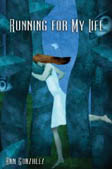
“Running For My Life,” written by GFW Support Pal Ann Gonzalez. Publisher WestSide Books. $16.95.
Andrea is a high school student who has PTSD as a result of being assaulted by her schizophrenic mother during an uncontrolled psychotic episode. This new novel by Gift From Within support pal, Ann, is a perfect book for a young person who suffers from PTSD or has experienced abuse. Fortunately for Andrea she has a wonderful dad, and a couple of very good friends who are supportive and understanding. Her best friend introduces Andrea to running and this new hobby also serves as a wonderful coping tool for Andrea. She says in the book that the sounds of running…the shh shh shh set her free. Andrea also has a good therapist who explains at the right time that she has PTSD and not Schizophrenia as Andrea felt that perhaps she was also suffering from the same disease as her mom. This is an important moment for Andrea.
This book will remind you of your high school years. The author adds humor which helps because you are so engaged by the profound sadness of Andrea’s life. It also carefully includes information that is very important, namely the benefits of social engagement which helps Andrea feel less isolated and at times deepens her resolve to move towards hope and resiliency. One cannot help feel Andrea’s pain and and there is a scene between Andrea and her mom that is scary but it is appropriate and handled sensitively. I believe high school students will learn about mental illness and will hopefully turn this understanding into compassion and empathy. Part of Andrea’s symptoms include depression. Depression among adolescents is widespread. We cannot ignore that more and more young people are dealing with parents and relatives and friends that are suffering from traumatic events and also biological disturbances.
Andrea also deals with anxiety, dissociation and the other sometimes overwhelming symptoms of trauma. Andrea struggles with various roles, being a student trying to manage schoolwork, her few friendships, a worried Dad, and the very scary proposition of a Mom returning home and all that entails.
I am very glad that the author showed what can occur during therapy sessions. I believe young people will feel less frightened about what an appropriate trauma therapist really does. The book also teaches young people not to feel blame or inadequate about dealing with mentally ill relatives. That is not our job but we are sometimes forced to do it anyway. We are not trained or taught in HS or at home what to expect in these types of circumstances. In my household we were taught to keep secrets and not talk outside the family. That doesn’t work. This book sheds some light on a difficult topic with sensitivity, warmth, humor and compassion. Kudos to first time author Ann Gonzalez. I look forward to reading more novels by Ann G.
Bru:
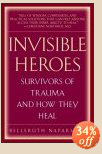
“Invisible Heroes: Survivors of Trauma and How They Heal,” by Belleruth Naparstek
(New York: Bantam Books, 2004). (Amazon rating 5 stars). $11.62.
This is simply the best book I’ve ever read about post-traumatic stress disorder. From the Foreword by Robert C. Scaer, M.D. author of The Body Bears the Burden: Trauma, Dissociation and Diesase, “This is a remarkable book that is likely to find application as a reference manual for trauma psychotherapists as well as an enlightening and educational book for trauma survivors and the general lay public.”
She breaks the book up into two parts. Part One is UNDERSTANDING TRAUMA. Using case studies from her thirty years of experience as a therapist, she explains: who gets PTSD, how people get PTSD, when, where and why people get PTSD. She continues with chapters on the physical, cognitive, emotional and behavioral effects and more case excerpts describing and illustrating all the details. It’s the first time I’ve seen all this information in one place and explained so well so it can be easily understood. For me the chapter on the cognitive effects of trauma was particularly helpful. It answered many lingering questions I’ve had about why and how my brain is working. It validated my experiences and helped me.
Part Two is HEALING TRAUMA. She explains how and why imagery heals trauma. She lays out a “step-by-step program with more than twenty scripts for guided-imagery exercises tailored to the the three stages of recovery, from immediate relief of anxiety attacks, flashbacks, nightmares, and insomnia, to freedome from depression and isolation, to renewed engagement with life.” She has a whole chapter ‘General Guided Imagery Wisdom and Tactics’ detailing how to do it and everything you need to do know. I was already well acquainted with spontaneous and guided imagery before I read this book, but all these scripts for particular things (like Protection and Support; Restful Sleep; Softening Pain, Ease Depression; Release Grief; Confidence; Anger and Forgiveness; Support Weight Loss; Connecting, Heart to Heart) are very helpful. I really like the three pages of affirmations that she suggested could be used in brief or longer sessions.
There are two important chapters at the end of Part Two: one on “Other Imagery-Based Therapies” and one on “Surprise Blessings: Gifts in the Rubble”. The information on other imagery-based therapies is very up-to-date and thorough. She explains each in detail; gives specific examples; and relates what research is showing about the success or not of each. This is the first time I’ve seen some of these therapies, so of them that I am using, actually written about so that I can share these therapies with others in more detail then my individual experience. At the beginning of the Surprise Blessings chapter she says, “As hard and painful as the journey to healing is, once people come through it, they usually discover that it brings an unaticipated windfall of blessings. This bounty, bought, admittedly, at far too heavy a price, is almost always shared readily with others.” And then goes on to share them!!
| Patti: “Understanding Trauma: A New Approach to Healing the Sources of Conflict .” by Janet Thornton. | ||||||||||||||||||||||||||||||||||||||||||||||
There is so much packed into this little book (69 pages) that it is difficult to do it justice in a two-paragraph review. Thornton deals with trauma and how it relates to conflict, how conflict stems from the effects of trauma, both personal and collective. Especially interesting were her thoughts about family trauma and how it can be passed on at the unconscious level from generation to generation. Conflict can be dealt with by acknowledgement and healing of the original trauma, both on a personal basis with personal trauma and by digging out the source of any family trauma.
I am delighted I was asked to read and review this scholarly work. I was left with so much to think about that I’m still under its spell. I feel, after reading it, that PTSD is much more widespread than perhaps any of us realize. Thornton’s explanation of PTSD is one of the best I’ve ever read and would be wonderful to share with those who care about us and are seeking to understand our pain (p. 29). It’s explained in a very simple and understandable way. She also includes a wonderful explanation of how triggering works and the mechanics of our brains that make it possible (pp. 32-38). Another area Thornton examines if how trauma is stored in the body and the different therapies that can release it and cause our bodies to be freer of its effects.
This small book is actually the introduction and first chapter of her book entitled “Healing Ancestry: A New Perspective on Peacemaking” which she is in the process of writing. I, for one, am looking forward to its publication so that I can read more on this fascinating subject. There is so much that is making sense to me after reading this little book. I highly recommend it.
for purchasing details, email Janet at jlthornton@supanet.com
| Rape & Recovery: |
Patti:
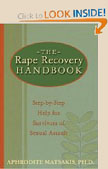
“The Rape Recovery Handbook: Step-by-Step Help for Survivors of Sexual Assault.” by Aphrodite Matsakis. (Amazon rating 4 stars). $11.53
The author has presented a compassionately written guide to help those who have suffered sexual assault. Her ample introduction outlines why sexual assault is so physically and psychologically devastating and then explains how the survivor will find this book helpful and how to properly use it. The author includes frequent exercises to complete throughout the book.
The author uses the first four chapters to assist the reader in getting prepared for the healing process. She deals with issues such as the importance of taking care of yourself, making the time to work on healing, having a support system, managing stress and anxiety and rewarding yourself for progress made.
Part two offers validation by exploring the “Facts and Myths about Sexual Assault,” its stages and the survivor’s own story and the stages she will go through in her own recovery. By exploring the myths abounding about assault the survivor will be able to deal with any self-blame or guilt feelings that have surfaced. She will come to understand the feelings she is dealing with since the assault and how these can present in various physical effects. Finally the survivor will learn about ways she can assist herself in the recovery.
Lastly, part three will aid the survivor in ridding herself of irrational thoughts and feelings about the assault by reconstructing the assault and examining it safely. Upon completing these last few chapters the survivor should be able to look at the assault differently, as a true survivor, minus the self-deprecating thoughts. She should feel more in control of her life and feel more hopeful.
I would like to note that the author includes two appendix that offer great assists. Appendix A deals with finding the proper counseling and avoiding hurtful programs (apparently there are quite of few bad ones). She also discusses finding support groups.
Appendix B offers helpful resources which are presented in groups by subject.
I reviewed this book from the outside, having not experienced sexual assault. I feel it is well-presented, easy to follow and offers lots of opportunities for the reader to be involved in her own recovery process. I think this book would be extremely helpful for anyone seeking healing from sexual assault.
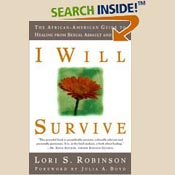
“I Will Survive: The African-American Guide to Healing from Sexual Assault and Abuse.” by Lori Robinson. (Amazon rating 5 stars). $10.85
This is an excellent, sensitively written guide for anyone who has suffered or who knows someone who has suffered from the trauma of sexual assault and abuse. It’s extremely useful for African American trauma survivors because it validates their feelings based on their traditional and cultural values that have contributed to their not reporting or seeking help.
Ms. Robinson explains that African American women generally react stoically to sexual assault and abuse. Their cultural history leads them to care of this indignation privately and move on. For African-American women, there is a stigma attached to reporting a perpetrator particularly if the perpetrator is a family member or friend. There is resistance to reporting an African American perpetrator because of the myth that still survives in our society that Blacks are more likely to rape than anyone else. And if the perpetrator is White, the history of slavery and the horrendous treatment their ancestors went through has the effect of discouraging reporting the perpetrator to the authorities. While both of these factors are on the decline today, they still affect the way African-American women respond to rape and sexual abuse. But “I Will Survive” is not so much about the past, as the present and the future, and it describes the changes that are being made by rape crisis centers educating men and women about personal responsibilities and not to let dictates from the past cloud the truth of sexual violence and justice for victims. It educates men of all races to the grim realities of sexual violence and how they too must become involved in the prevention and healing.
Ms. Robinson suffered a sexual assault in 1995 and rather than hide she courageously wrote this book to help other women and their families cope with the devastating effects and aftermath. A victim, she says, can become a “survivor and a thriver.” Women who have been abused can, according to Ms. Robinson, recover and have the life they deserve. She points out that while life may take on a new meaning because the victim may be changed forever that change does not prevent future happiness. This book is essentially the A-Z guide for women and men of what to do after an assault including coping techniques, legal procedures, church and faith; and assists you through the psychological and emotional journey of healing. I recommend this book highly to survivors, family members, law enforcement, and anyone who cares about sexual violence and how to stop it from ruining the lives of people in our communities.
“Surviving The Silence: Black Women’s Stories of Rape.” by Charlotte Pierce-Baker. (Amazon rating 5 stars). $11.86
This amazing book should be read by anyone interested in sexual violence and the painful long road to recovery. The author, a rape survivor herself, reveals her story and the stories of other black women. Be prepared for the brutal revelations and out pouring of emotions that will shock, enlighten, educate and anger you.
I am also grateful that the author included the stories of the black men who comforted, and supported their women and families. As a white woman, I felt like I had been given the rare opportunity, a glimpse, like reading the secret diaries that reveal the heart and soul of a human being under the most difficult of circumstances; and then you lift your head, and acknowledge that you understand sexual violence in a way you had not before. Perhaps it never occurred to you that black women might have cultural traditions, and have to endure stereotypes that would prevent them from speaking out about their ordeal.
These stories will haunt you because the women are revealing painful secrets they felt society did not really want to hear. Strength and courage are portrayed time and again with each story. These women are heroes. I think women of all races should be reading about the sexual violence experience of black women. “Silence runs deep,” and as one survivor says
“We need to work together (black women) I think by our silence, we are saying it’s okay. We should stop fighting these little individual battles. We need to make it as a family of black women.” The author’s next book will be on Bi-Polar Disorder and the role of the caretaker, and I look forward to reading it as she is a wonderful and compelling writer.
Cindy Lou:
“She’s Come Undone.” by Wally Lamb. (Amazon rating 4 stars). Oprah’s Book Club. $7.99.
She’s Come Undone is an amazing book which at first is seemingly for entertainment only. I find that I read this book at least once a year. Even though it’s in the entrainment “section” it truly is a book directed for inner healing. This book is written from a woman’s perspective yet it’s a man writing it. Oddly enough, he’s dead on for the most part though. The story opens as the main character is a young child. We follow her through her childhood, youth in which she experiences rape, and young adult years all the way till she finds healing. This is a book that made me hope that I too could eventually find healing.
Ellen:
“Transitions: Making Sense of Life’s Changes,” by William Bridges. (Amazon rating 4.5 stars). $10.85.
Transitions: Making Sense of Life’s Changes by William Bridges is wonderful book for anyone going thru a break-up or major life-style change. It talks about that “void” place which everyone feels during a transition. It’s about recognizing endings, the “neutral zone,” and the new beginning. “It’s a road map of the transition process”. It has helped me feel less isolated.
Patti:
“Peaceful Heart: A Woman’s Journey of Healing,” by Aimee Jo Martin. (Amazon rating 5 stars). $13.95.
In Peaceful Heart: A Woman’s Journey of Healing, Aimee Jo Martin documents her life before and after her brutal rape when she was 17 years old. The account of the rape is graphic and may trigger victims of sexual assault. However, it may also be comforting to read of one victim’s difficult but victorious search for healing. Martin did not speak of her attack for many years, even to family members. When she did seek help she began to understand how her early family dynamics and her low self-esteem added to the effects of the traumatic attack and its effect on her feelings about herself.
Martin’s book was meaningful to me because it demonstrated how one’s feelings about oneself can inhibit healing after a traumatic event and how a sensitive nature can inhibit a woman’s concentrating on herself when she is used to focusing her energy on protecting others. Also very touching was how she was open about her need for safety and her problems with trust. Although I am not a victim of sexual assault I found myself identifying with Martin’s struggles in so many areas. Therefore her book is appropriate reading for any victim of PTSD. In her book Martin opened up her life and her wounds so that we may have an intimate view inside of her and, hopefully, find hope and direction for healing. Because she described her setbacks I was encouraged to not feel guilty when I have those bad days and my progress seems nil. Martin helps us understand that the road to healing is a long road beset with hills and valleys but that it’s worth it to find the help we need. Her graphic openness about her pain causes the victim to be sympathetic both with Martin and with herself.
This is an excellent book to share with significant others to help explain the effects of PTSD and how to offer support.
Healing & Spirituality:
Connie:
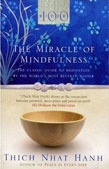
The Miracle of Mindfulness: The Classic Guide to Meditation by the World’s Most Revered Master by Thich Nhat Hahn.
A Buddhist monk teaches the old arts of mindfulness. Mindfulness is the art of being in the here and now. Focusing on the task at hand. Not thinking of all the tasks for the rest of the day or the past ones not finished, but now. Focusing on how the fingers move as I write this review is mindfulness. Listening to my breath entering my nose and lungs, then moving out through my nostrils. I went shopping at a thrift store one day for a book to read during my lunch hour. There it was, “The Miracle of Mindfulness.” I have purchased this book three times because I loan it out and it stays with that person. This book has been my guide to learning how to breath, how to listen, and now finally how to be present in my body. To this day when I find myself anxious, wanting to pace, I listen to my breath as I do the pacing, the thought meandering, what ever it is I am doing I seek to stay present. The anxiety goes away and I feel great, sometimes ready for a nap, but learning the Zen meditation skills for mindfulness is a terrific tool. This is a terrific tool to have handy.
Connie:
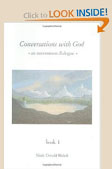
Conversations with God (Trilogy) (hardcover) by Neale Donald Walsch. (Amazon rating 5 stars).
The book Conversations with God, Book 1 was recommended to me shortly after it was published in 1996, but this was a time of searching to find a God I could do business with. It was over the next four or five years that I discovered the rage I felt with God, at least the Southern Baptist version. Many years of prayer occurred, then one day I came across the title once again during a book search for another title. This time I took head and purchased the book. I was very surprised to discover a dialogue that sounded palatable, even believable to me. It was as if they, Neale Donald Walsch and God were talking about and to me.
Neale Donald Walsch tells a bit about his life in the first book, his disappointments, anger, discouragement, resentments, and how he began the dialogue that was published in three books. The conversation begins with Walsch sitting down with pencil and paper and writing an angry letter to God. Something I had done just a few days before and again three or four more times since. I discovered that it was safe to be angry with God, to tell him how angry and hurt I was. Eventually I was able to listen and hear that he had never deserted me, that each time I cried out to her, she was there.
The Conversations with God Trilogy covers every topic there seems to be on the face of this earth in a way that is not blasphemous, dangerous, or insane. Though one with hate and doubt could find the insanity if sought. It could be debunked just as anything can be. But the message in these books, more so for me in the first book is the belief that God does listen, care, responds, and is not judgmental as most want to believe. It brought home for me the belief I held for many years, that God could not be so hateful as to condemn his Children. That God is what we choose to make him or her.
Reading and rereading this book now for the past 10 years has brought me so much peace, making it possible for me to believe once again in a Divine presence and since we live in a dual world it was alright to return to the childhood beliefs of a God and Goddess, the Divine Mother and Father. The pages are well read, the cover is semi safe with the dust jacket. Overall this is the book that began a calmer journey to a Divine Power that was not that of the earlier beliefs of others, a vengeful and hateful god that would let me suffer at the hands of man and woman. Bringing me to understand that as humans we were gifted with the greatest power of all: Choice. The result of Free Will. This translated to since we each have free will, the power to choose, then she could not have stopped the horrors in my life, but did send me the messengers and guides to bring me to this day. There are times I wish I would have known then what I know now, the asking and receiving of peace, protection, healing, and it would have been mine.
I so recommend this book to anyone who is indecisive, struggling to bring a male or female presence into their life as a Divine power. When read with an open mind and willingness to listen beyond one’s history, the messages written in Conversations with God is clear.
Patti:
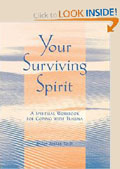
Your Surviving Spirit: A Spiritual Workbook For Coping With Trauma. Oakland, CA: New Harbinger Publications, Inc. 2003. Dusty Miller. $19.95.
Having read, reviewed and been helped by Dusty’s Women Who Hurt Themselves, I was pleased to have the opportunity to review another of her works. Not surprisingly I found this work just as meaningful and helpful. Trauma touches all aspects of our lives, spirituality included. Many of us have trouble reconciling our prior view of a benevolent power with what “was allowed” to happen in our lives. Dusty helps us to find our way back to our spiritual side, although it may be different from what it used to be.
Regardless of when your trauma happened or what type of trauma it was, you will find this workbook helpful if you feel the desire to regain spirituality. Even if you do not feel that desire, I would still recommend this book because you may have a spiritual hunger you are unaware of.
By including stories of other trauma victims who found a deep spirituality as a result of their trauma, the workbook gives hope that we too can find our way back. First we are helped to discover where we are in our level of spirituality since the trauma occurred and how our beliefs have been altered, if we still meditate and pray or have turned to other avenues for help. We are taught aids to strengthen our spirituality and to create healthier spiritual views in contrast to faulty ones we may have learned in childhood. Most valuable in my view is how the author helps us to understand compassionately how the trauma has affected us and to accept the prospect of a caring and loving power outside ourselves that longs to support us in our journey to healing. It is much easier to accept the idea of a compassionate power when we are able to be compassionate with ourselves.
By answering the questions we can understand where we are in our spiritual walk, how to challenge some of own negative misconceptions and create within ourselves a healthy, vibrant and living spirituality that we all need, even more so because of the harm done to use. We can then use this knowledge to be more open with others and to reach out to them because we have found a renewed strength within ourselves.
This is a great workbook. If you are struggling with faith I especially recommend it.
Red:
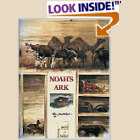
Noah’s Ark by Rien Poortvliet. $18.15 (Hardcover).
The animals drawn and painted by the famous Dutch artist and naturalist Rien Pootvliet are admired all over the world. In this 240 page book he applies his artistry and knowledge of animals to the greatest animal story of all – Noah’s Ark.
With reverence, imagination and humor he ponders on this biblical happening, considering it from every angle. I liked how he examined the situation for Noah building the Ark amongst a people that were known for being violent: It had never rained upon the earth before, but here was Noah building an Ark for protection against the coming Flood = how he would have attracted a lot of attention in order to do this; how people were making fun of him for doing the building work. This was captured well in the art work.
He noted that people did not listen but animals paid better attention than what humans did = animals listen better than humans do. This artists’ pen and brush bring this situation to life in meticulous and fascinating detail. He asks and answers – thru his drawings and brief comments – all the relevant questions: How in those ancient days did Noah manage to build a 3-story wooden structure capable of holding “two of every living thing”? What were the thoughts of the people who watched the Ark being built? Was there a problem with restlessness during the animals’ long confinement in the Ark? How in the world was the Creator able to invent the infinite number of animals?
The book measures: 14″ x 18″ and the picture say all that words cannot. I not only enjoyed the book, but every child that has seen it has talked so much about the book to their parents that we get these visits and the parents announce: “We came over to see the book: Noah’s Ark”- The wonderful and imaginative drawings help make this a very cheerful and enjoyable book to have in your collection.
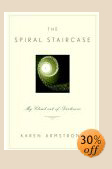
Armstrong, Karen. “The Spiral Staircase: My Climb Out of Darkness.”
Knopf; 1st edition, March 2004. $11.20.
Karen Armstrong’s autobiography of her 7 years spent in a convent, starting from the age of l7 (over her parent’s objections), is an interesting and poignant account of a former nun’s quest to find God. Karen Armstrong didn’t find him where she thought he would be. I think some religious people may be upset with this book, but I don’t believe that it’s a condemnation of the Church. Rather it demonstrates that we can find our own way towards enlightenment, and sacredness. T. S. Eliot’s Ash Wednesday was a model for her struggle, and it’s brilliant how she uses his poetry to find herself. I think that Karen Armstrong does find God, but not the way the Church might have preferred her to.
It took years after she left the Church to discover her true self. She had an uphill battle because of epilepsy. Her years in the Convent were not without some joy, but mostly she felt a failure because she could not feel God in her life. She did not feel the “glory” of finding God like she thought the other Nun’s had, and felt ashamed and unworthy. It took courage for Ms. Armstrong to leave the Convent and reenter a world where she found herself left behind. Seven years away from culture and politics left her feeling isolated and different. She felt that perhaps since she was a very bright student she would publish her thesis, become a professor and have a decent life. This did not happen. The journey that she reveals is both heartbreaking and inspirational.
Karen suffered years of pain and confusion from the symptoms of epilepsy but, instead of being told to see doctors, she began seeing psychiatrists who felt the panic attacks and “absent mindedness” were from her early childhood years. Some of the nuns felt that her mind was the problem, perhaps her lack of faith and/or proper meditation and prayer.
Karen finally found relief and hope after finding a doctor who prescribed the proper drugs to deal with the debilitating effects of epilepsy. When she left the doctor’s office she felt alive for the first time in many years. She was glad that there was an answer to what she was experiencing. Nothing was wrong with her mind. Karen became a teacher, started a writing career which led to hosting a documentary on religion that opened her eyes and heart.
Writing about Christianity, Judaism and Islam helped her find her true calling in life and the peace and spiritual life she didn’t find from years of silent prayer. Her authentic self soon emerged. She embraced all people, all religions with compassion and honesty. Most importantly, she teaches us to find ourselves, to look, ask questions, and not be beholden to dogma and tradition. She teaches that there is a place for us if we are determined to live with the pain, despair and hardships that may haunt us in our self-discovery. We shouldn’t hide but openly challenge and provoke ourselves. Karen Armstrong struggled and persevered and this powerful and brilliant teacher is giving us all a lesson about learning to find peace within ourselves. I learned from Karen Armstrong and am interested in reading her other books.
Self Harm: |
Miller, Dusty. “Women Who Hurt Themselves: A Book of Hope and Understanding.”
New York, NY: Basic Books: 1994.
Dusty Miller’s “Women Who Hurt Themselves” deals with what she calls Trauma Re-enactment Syndrome (TRS), a tendency that causes some women to relive childhood pain by harming their own bodies. In her book Miller examines the relationship between childhood suffering, which was inflicted on the child by someone else, and self-inflicted pain that occurs in adulthood. After examining the dynamics of why women harm their own bodies, she details the type of therapy that is most successful in treating these women, including a chapter for the victim to share with her therapist. She includes the need to understand PTSD in the victim”s suffering. Miller discovered the often-used concept of the victim’s tendency to “act out” the role of her “abuser,” her “passive bystander” and her own role as “victim.”
I found this book to be very comforting. Since self-mutilation is so misunderstood it is something the victim finds difficult to talk about. There is a definite veil of secrecy associated with it. Since it serves a definite purpose to the victim, she guards her self-mutilation as if it was a dear friend. In fact, self-mutilation, strangely enough, can be a lifesaver until the victim gets into successful therapy and is able to replace it with more healthy ways of coping. I highly recommend the book for those who may be involved in any type of self-pain or mutilation, as well as for those who have friends or loved ones they suspect are engaging in this practice. Miller deals with the subject in a caring, compassionate and knowledgeable manner.